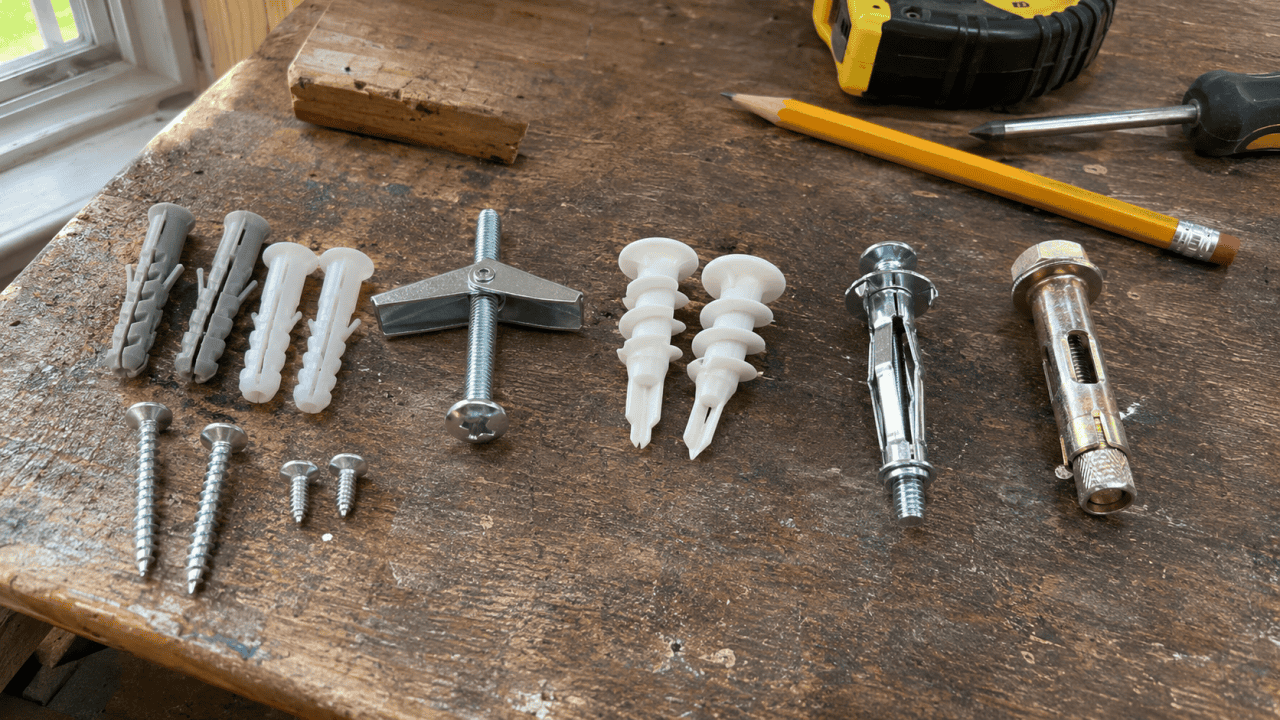
A screw driven straight into drywall holds almost nothing. Drywall is soft gypsum between two sheets of paper, and the threads tear out under a small load. A wall anchor fixes that by spreading the load over more of the wall, or by gripping the back of the board.
Choosing one comes down to three questions: what is the wall made of, how heavy is the thing, and which way does it pull. This guide answers each one, then covers every common anchor type, the hole size it needs and what to do when one fails.
Pick your anchor by what you are hanging
| What you are hanging | On drywall, with no stud | Notes |
|---|---|---|
| Small picture frame, clock | Plastic expansion anchor | A picture hook with a nail also works for very light frames. |
| Large mirror, heavy frame | Self-drilling anchor or molly bolt | Use two anchors and keep them level. |
| Curtain rod | Self-drilling anchor or molly bolt | People pull on curtains. Go one class stronger than the weight suggests. |
| Towel bar, toilet paper holder | Molly bolt or strap toggle | These get leaned on. Skip the plastic plugs in the box. |
| Floating shelf | Strap toggles, plus at least one stud | A shelf levers outward. See the section on pull direction. |
| TV mount | Studs | Mount makers call for studs. Use toggles only where a second fixing misses a stud. |
| Wall cabinet | Studs only | Never hang cabinets on anchors alone. |
| Grab bar, handrail | Studs or solid blocking only | A person’s full weight will be on it. |
Step one: what is the wall made of?
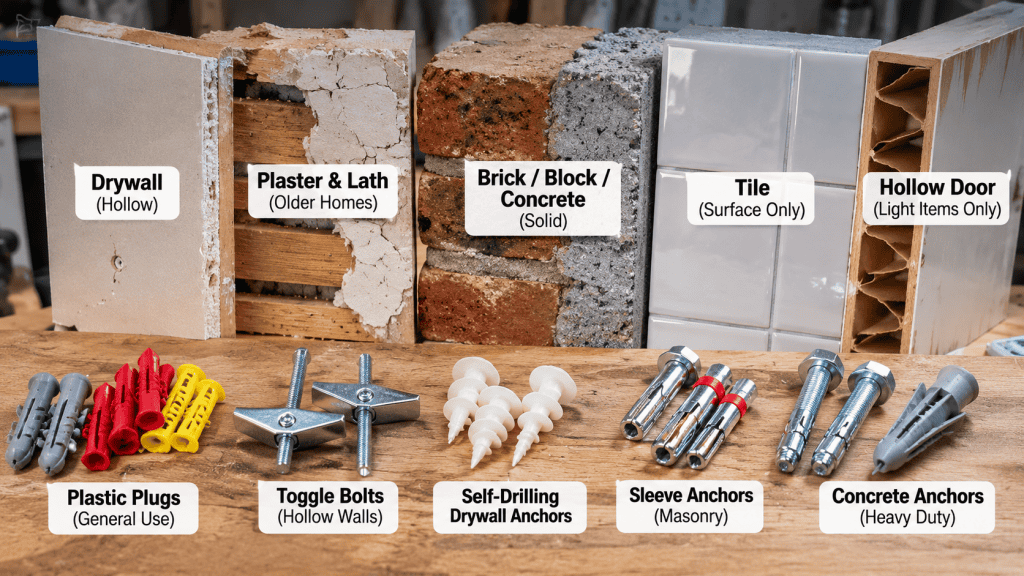
- Drywall: sounds hollow when you knock. A pushpin goes in easily. Most interior walls in newer homes are 1/2-inch drywall.
- Plaster and lath: found in older homes. It feels harder, a pushpin will not go in, and drilling gives sandy gray dust, then wood.
- Brick, block or concrete: solid and cold, with gray or red dust when drilled. Common for basement and exterior walls.
- Tile: the tile is only the surface. What matters is the wall behind it.
- Hollow door: a thin skin over a mostly empty core. Only light items, with small hollow-wall anchors.
Turn off the power and take an outlet cover off if you are unsure. The edge of the cutout shows you the wall material and its thickness.
Step two: how heavy, and which way does it pull?
The same anchor can hold very different loads depending on the direction of the force.
- Shear is a load that pulls straight down along the wall, like a picture hanging flat. Anchors are strongest this way.
- Pull-out, also called tension, is a load that pulls the anchor straight out of the wall, like a hook in a ceiling. Anchors are weakest this way.
- Leverage is a mix of both. A shelf that sticks out 10 inches pries its top fixings outward, and the further out the weight sits, the harder it pulls.
This is why a set of anchors that holds a 40-pound mirror can let go of a 20-pound shelf. Count everything that will sit on a shelf, not only the shelf.
Why the weight ratings disagree
Look up toggle bolts and you will find ratings from 50 pounds to over 250. Three things explain it:
- Ultimate load vs working load. The big number on the pack is often the load at which the anchor failed in a test. The safe working load is a fraction of that.
- Per anchor vs per pair. Some charts quote one anchor, some quote two.
- The wall. Ratings assume sound drywall of a stated thickness. Old, damp or patched drywall holds less.
- Direction. Most ratings are for shear. Pull-out figures are lower.
My rule: treat one quarter of the package rating as the working load. More anchors spread the load, but two anchors do not make a weak wall twice as strong.
The main types of wall anchor
1. Plastic expansion anchors (plugs)
A ribbed plastic sleeve that you tap into a drilled hole. The screw spreads the sleeve so it presses against the sides of the hole. In drywall the grip is weak, because there is only half an inch of soft gypsum to press against. In brick and concrete, the same plug holds much better.
- Holds: about 5 to 25 pounds in drywall, as an ultimate load.
- Use it for: small pictures, clocks, smoke alarms, light fittings on masonry.
- Avoid it for: shelves, towel bars, anything on a ceiling.
2. Self-drilling (threaded) anchors
A fat, coarse-threaded anchor in zinc or nylon that screws straight into drywall with a screwdriver. No drilled hole is needed. The wide threads grip much more gypsum than a plug.
- Holds: about 50 to 75 pounds ultimate in 1/2-inch drywall.
- Use it for: mirrors, medium pictures, light shelves, curtain rods.
- Avoid it for: plaster, which cracks, and ceilings.
3. Molly bolts (hollow-wall anchors)
A metal sleeve with a screw through it. As you tighten the screw, the sleeve folds outward behind the wall into a wide flower shape that clamps the board. The screw can be taken out and put back without losing the anchor.
- Holds: about 25 to 95 pounds ultimate, depending on size.
- Use it for: towel bars, coat hooks, medium shelves, plaster walls and tile over drywall.
- Avoid it for: very thick walls, unless you buy the long version.
4. Spring toggle bolts
A bolt with a pair of spring-loaded wings. You fold the wings, push them through a large hole, and they snap open behind the wall. They spread the load over the largest area of any hollow-wall anchor.
- Holds: about 140 to 150 pounds ultimate for wing toggles.
- Use it for: heavy mirrors, shelves, ceiling fixtures rated for toggles.
- Avoid it for: jobs where you may remove the bolt. Take the bolt out and the wings drop inside the wall.
5. Strap toggles
A metal bar on plastic straps. You push the bar through the hole, pull the straps to seat it against the back of the wall, slide a cap down and snap the straps off. The bar stays in place when the bolt is out, and one person can install it easily.
- Holds: about 160 to 265 pounds ultimate.
- Use it for: heavy shelves, TV mount fixings that miss a stud, anything you may take down and put back.
- Avoid it for: light pictures. They are more than you need and leave a 1/2-inch hole.
6. Masonry screws
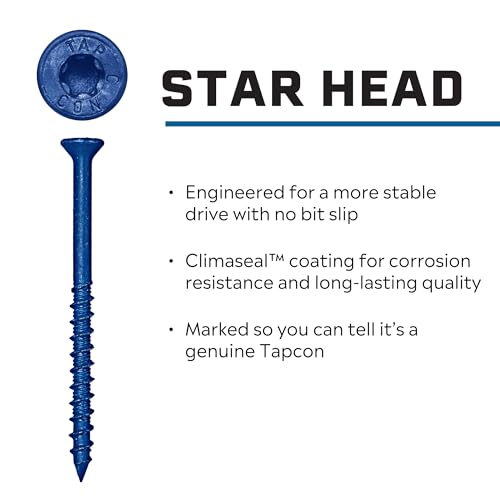
Hardened blue screws that cut their own thread in a hole drilled in concrete, brick or block. No plug is needed.
- Holds: high loads in solid masonry. Follow the maker’s figures.
- Use it for: shelves, brackets and framing on basement and garage walls.
- Avoid it for: soft or crumbling mortar and old soft brick, where they can strip the hole.
7. Sleeve and wedge anchors
Heavy steel anchors that expand inside a hole in concrete as you tighten the nut. They are for structural loads such as railings, racking and machinery.
- Holds: very high loads in sound concrete.
- Use it for: heavy shelving and anything bolted to a concrete floor or wall.
- Avoid it for: ordinary household hanging. They are permanent.
Wall anchor comparison
| Type | Wall | Strength | Hole needed | Removable? |
|---|---|---|---|---|
| Plastic expansion | Drywall, masonry | Light | Small drilled hole | Yes, pulls out |
| Self-drilling | Drywall | Medium | None | Yes, unscrews |
| Molly bolt | Drywall, plaster, tile over drywall | Medium to heavy | Medium drilled hole | Screw yes, sleeve stays |
| Spring toggle | Drywall, plaster, hollow block | Heavy | Large drilled hole | Wings fall into the wall |
| Strap toggle | Drywall, plaster, hollow block | Heaviest hollow-wall option | 1/2 in. | Bolt yes, bar stays |
| Masonry screw | Concrete, brick, block | Heavy | Small drilled hole, hammer drill | Yes, unscrews |
Drill bit size chart
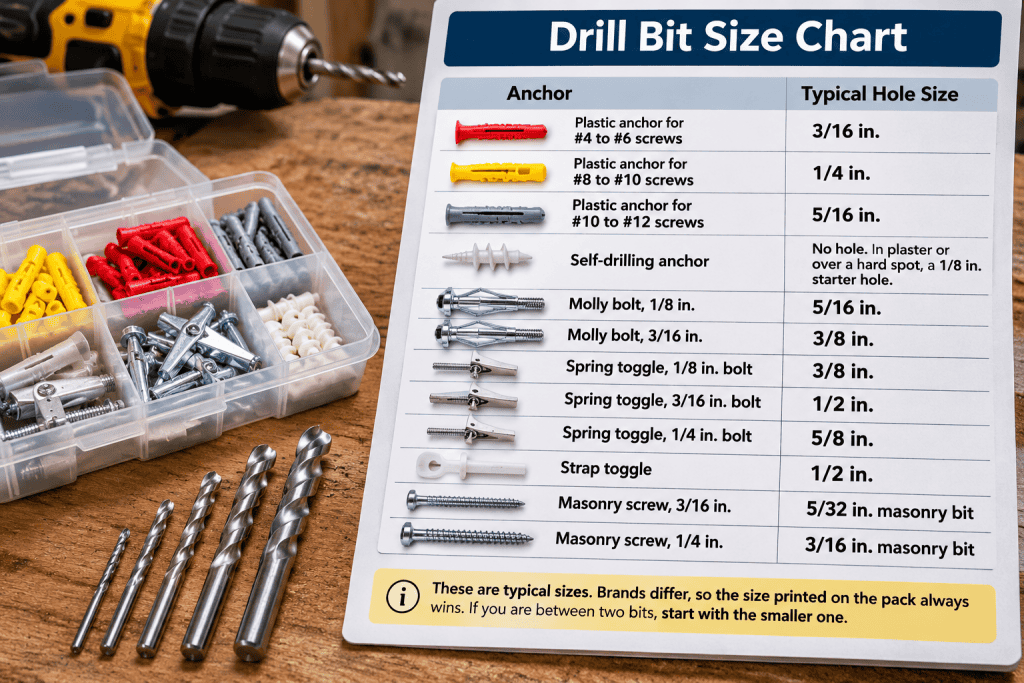
| Anchor | Typical hole size |
|---|---|
| Plastic anchor for #4 to #6 screws | 3/16 in. |
| Plastic anchor for #8 to #10 screws | 1/4 in. |
| Plastic anchor for #10 to #12 screws | 5/16 in. |
| Self-drilling anchor | No hole. In plaster or over a hard spot, a 1/8 in. starter hole. |
| Molly bolt, 1/8 in. | 5/16 in. |
| Molly bolt, 3/16 in. | 3/8 in. |
| Spring toggle, 1/8 in. bolt | 3/8 in. |
| Spring toggle, 3/16 in. bolt | 1/2 in. |
| Spring toggle, 1/4 in. bolt | 5/8 in. |
| Strap toggle | 1/2 in. |
| Masonry screw, 3/16 in. | 5/32 in. masonry bit |
| Masonry screw, 1/4 in. | 3/16 in. masonry bit |
These are typical sizes. Brands differ, so the size printed on the pack always wins. If you are between two bits, start with the smaller one. A hole that is too tight can be opened up. A hole that is too big cannot be made smaller.
How to install the four main types
Plastic expansion anchor
- Drill a hole the size printed on the pack, as deep as the anchor is long.
- Tap the anchor in with a hammer until the rim is flush with the wall.
- Hold the fixture in place and drive the screw. Stop when it is snug.
Self-drilling anchor
- Push the point into the wall at your mark.
- Turn it in with a #2 Phillips screwdriver, or a drill at low speed, until the head is flush.
- Drive the screw through the fixture into the anchor.
Molly bolt
- Drill the hole and tap the molly in until the teeth under its head bite into the wall.
- Tighten the screw. You will feel it get harder as the sleeve folds behind the wall. Stop when it is firm.
- Back the screw out, put it through the fixture and drive it back in.
Strap toggle
- Drill a 1/2-inch hole.
- Hold the metal bar flat along the straps and push it through the hole.
- Pull the straps toward you until the bar sits flat against the back of the wall, then slide the cap along the straps until it is flush with the wall.
- Snap the straps off at the cap.
- Put the bolt through the fixture and into the bar, and tighten.
Any cordless drill does these jobs. If you need one, see my list of the best cordless drills under $100. For tiled walls, drill the tile first using the method in how to drill into tile without cracking it.
When it goes wrong
- The anchor spins in the hole. The hole is too big or the gypsum has crumbled. Pull the anchor out and go up to a larger type: a plug becomes a self-drilling anchor, a self-drilling anchor becomes a molly or toggle.
- The anchor pulled out of the wall. It was overloaded or the wall is weak there. Do not put the same anchor back. Patch the hole and move the fixing a couple of inches, or use a toggle, which grips the back of the board.
- The hole is too big. Use a toggle, which needs a big hole anyway, or patch and redrill.
- You hit wood halfway in. That is a stud or blocking, and it is good news. Skip the anchor and drive a wood screw at least 1 inch into the wood.
- You hit metal or something hard. Stop. It may be a nail plate that protects a pipe or cable, or a metal stud. Move the hole.
- The screw head stripped while tightening. See how to remove a stripped screw.
Removing anchors and patching the hole
- Plastic plug: thread a screw in two turns and pull it out with pliers. If it will not come, cut the rim off with a utility knife and push it in.
- Self-drilling anchor: unscrew it counterclockwise.
- Molly bolt: remove the screw, then tap the head just below the wall surface with a nail set, or bend the head tabs and push the sleeve into the wall.
- Toggles: remove the bolt and push what is left into the wall cavity.
Fill small holes with spackle, let it dry, sand flush and touch up the paint. Holes of 1/2 inch and larger need a second coat, or a small mesh patch under the filler.
Special cases
- Ceilings: the load is straight pull-out, the weakest direction. Use toggles or screw into a joist, and never hang anything heavy or anything over a bed from plastic or self-drilling anchors.
- Plaster and lath: drill slowly with a masonry bit to avoid cracking. Molly bolts and toggles work well. Self-drilling anchors do not.
- Tile: drill the tile with a tile bit, then set the anchor in the wall behind it, not in the tile.
- Hollow doors: small molly bolts or light hollow-door anchors only, and only for light items like hooks.
When not to use an anchor at all
A screw into a wood stud is stronger than any anchor in drywall. Studs are usually 16 inches apart, center to center. Find one with a stud finder, by knocking, or by measuring from an outlet box, which is fixed to the side of a stud.
Use studs or solid blocking, and no anchors, for wall cabinets, grab bars, handrails, pull-up bars, wall-mounted desks and anything a child might climb. For a TV, fix the mount to studs.
Anchors worth buying
These five picks are based on their Amazon listings (retrieved 2026-11-16). I have not tested them side by side. Check the current price before you buy.
Light items: KURUI 270-piece plastic anchor and screw kit
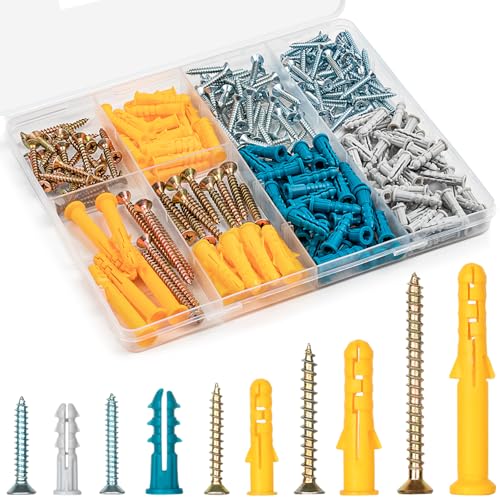
A box of 135 plastic anchors with 135 matching screws in five sizes, from #6 to #8. KURUI is not a tool brand I know, but a sorted kit like this saves hunting for a plug and a screw that fit each other. Keep it for pictures, clocks and other light things.

Check the current price of the KURUI anchor kit on Amazon
Medium items: E-Z Ancor Twist-N-Lock 75 lb self-drilling anchors

Fifty self-drilling anchors with #8 x 1-1/4 inch screws, for 1/2-inch or 5/8-inch drywall. No drilling is needed, and the listing says they give an audible click when set and sit flush with the wall. The 75-pound figure is the package rating, so apply the one-quarter rule.

Check the current price of the E-Z Ancor anchors on Amazon
Plaster and bathroom fittings: Glarks 80-piece molly bolt kit

Eighty zinc-plated steel molly bolts in six metric sizes, from 4 x 32 mm to 6 x 65 mm, in a sorted box. The listing gives drywall, plaster and tile as uses. Glarks is another kit brand and not a big name, but a range of lengths is what you need for walls of different thickness.
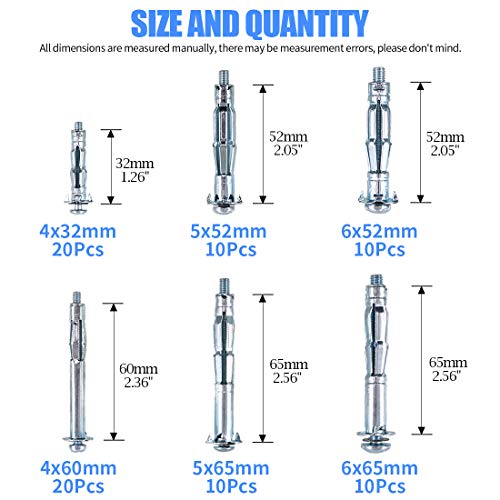
Check the current price of the Glarks molly bolt kit on Amazon
Heavy items: TOGGLER SNAPTOGGLE with 1/4-20 bolts, 20 pack
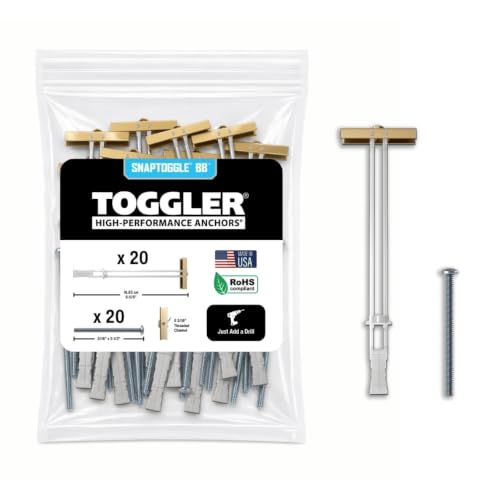
The strap toggle most people mean when they say “snap toggle”. The listing rates it at 265 pounds in drywall and says it fits hollow walls from 3/8 inch to 3-5/8 inches thick. The bar stays in the wall when you remove the bolt, and it is made in the USA. This pack includes the bolts.

Check the current price of the TOGGLER SNAPTOGGLE pack on Amazon
Brick and concrete: Tapcon 3/16 x 1-3/4 inch concrete screws, 75 pack
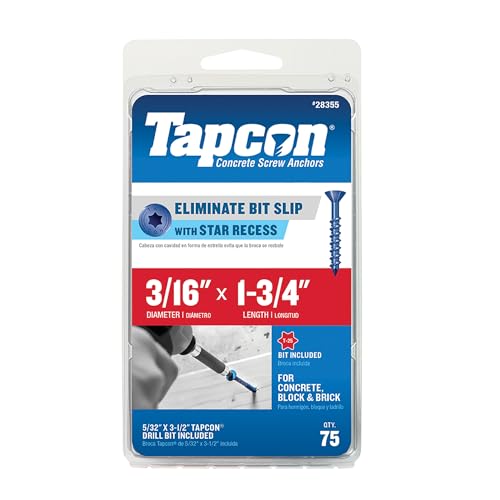
Blue masonry screws for concrete, brick, block and stone, with a star head that resists stripping. The pack includes the matching masonry drill bit and a T-25 driver bit, which removes the guesswork on hole size. You will need a hammer drill for concrete.
Check the current price of the Tapcon screws on Amazon
Frequently asked questions
How much weight can a drywall anchor hold?
It depends on the type: roughly 5 to 25 pounds for plastic plugs and up to 265 pounds for the strongest strap toggles, as ultimate loads in sound drywall. Use about a quarter of the package rating as your working load.
Toggle bolt or molly bolt?
A toggle is stronger. A molly needs a smaller hole and keeps its place when you take the screw out. Use mollies for medium loads and bathroom fittings, and toggles for heavy loads.
Do I need an anchor if I hit a stud?
No. Drive a wood screw at least 1 inch into the stud. That is stronger than any anchor.
Can I hang a TV on drywall anchors alone?
I would not. Mount makers call for studs, and a TV on an arm puts a lot of leverage on the top fixings. Fix the mount to studs, and use strap toggles only for extra fixings that miss a stud.
Can I reuse an anchor hole?
With the same anchor, usually not. The hole is worn. Go up to a larger anchor type in the same spot, or patch and move over.
What size drill bit do I need for a plastic anchor?
Use the size printed on the pack. As a guide, 3/16 inch for small plugs, 1/4 inch for the common #8 size and 5/16 inch for large ones.
The bottom line
Look for a stud first. With no stud, use plastic plugs only for light things, self-drilling anchors or molly bolts for medium loads, and strap toggles for heavy ones. In brick and concrete, use masonry screws. Work to a quarter of the package rating, think about which way the load pulls, and put cabinets, grab bars and TVs on studs.