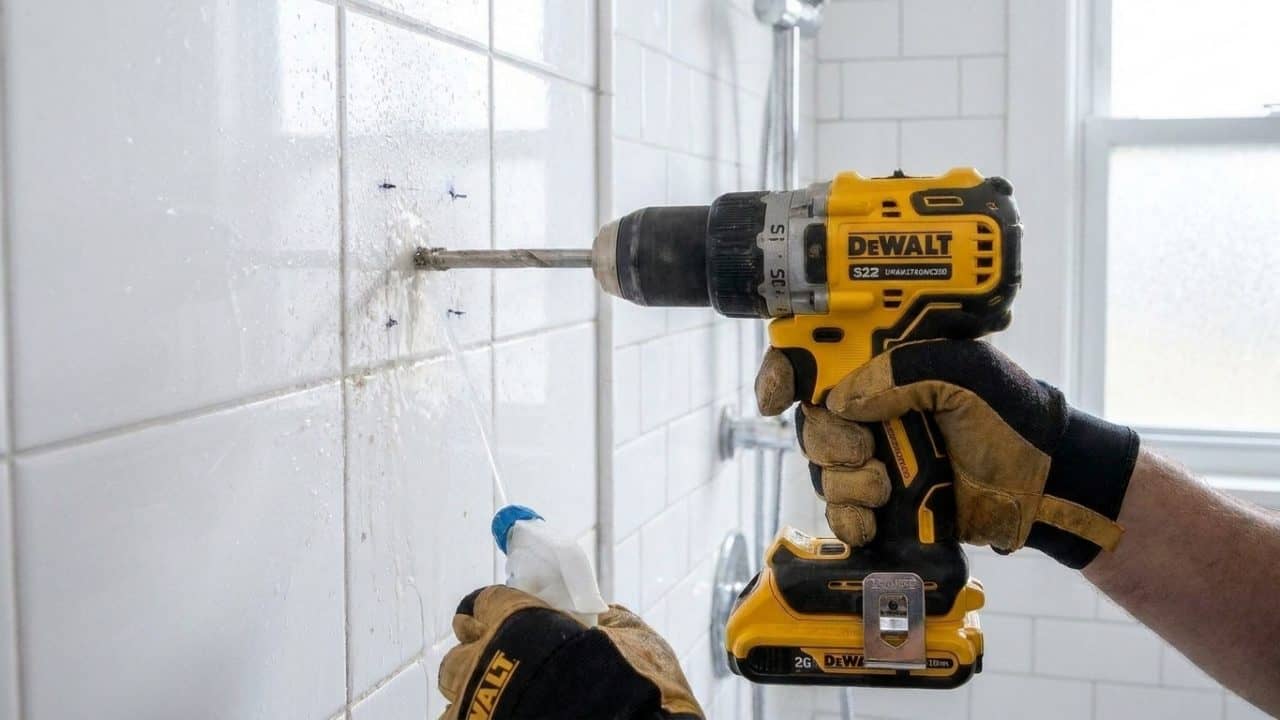
Tile cracks for a few simple reasons: the wrong bit, hammer mode, too much speed, too much pressure, or heat. Take those away and drilling tile is slow but safe. You need the right bit, a piece of tape, low speed, a little water and a drill with the hammer action switched off.
This guide covers ceramic and porcelain wall and floor tile, from marking the spot to fitting the anchor. It also shows which bits are worth buying, because the bit matters more here than the drill.
Why tile cracks when you drill it
- Hammer mode. The hammering that helps in brick will shatter the glazed face of a tile.
- Heat. A dry bit at high speed gets hot fast. Heat ruins the bit and stresses the tile.
- Pressure. Leaning on the drill bends the tile over any small gap behind it.
- A skating bit. Glaze is smooth. A bit that slides can scratch or chip the surface before it starts to cut.
Tiles also crack more easily near their edges and over hollow spots where the adhesive did not cover the back. Tap the tile with a knuckle. A hollow sound means there is a gap behind it, so drill there with extra care or move the hole.
Ceramic or porcelain? Check before you start
The type of tile decides the bit. Ceramic is softer. Porcelain is fired harder and denser, and it wears out ordinary tile bits quickly.
- Check the box or a spare tile. The label says which it is.
- Look at an edge. On ceramic, the body under the glaze is usually a different color, often red, tan or off-white. Porcelain is usually the same color all the way through.
- Try a drop of water on the unglazed back of a spare tile. Ceramic soaks it up quickly. Porcelain barely absorbs it.
- If you can’t tell, treat it as porcelain and use a diamond bit. A diamond bit cuts ceramic too.
Which drill bit for which tile
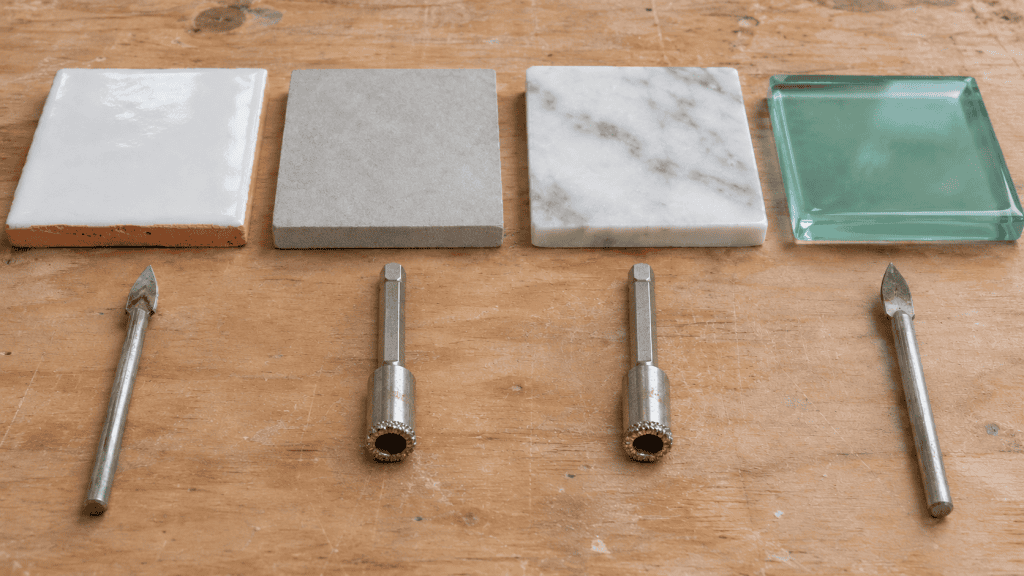
| Material | Bit to use | Water? |
|---|---|---|
| Ceramic wall tile | Carbide spear-point tile bit, or diamond | Helps, a little is enough |
| Porcelain tile | Diamond bit, or a carbide bit made for porcelain | Yes, unless the bit is made for dry use |
| Natural stone (marble, granite) | Diamond bit | Yes, unless the bit is made for dry use |
| Glass tile | Carbide spear-point glass bit, or diamond | Yes, always |
A standard masonry bit can get through soft ceramic tile, but its blunt tip skates on the glaze and it tends to chip the surface. A wood or metal twist bit will not cut tile at all.
What you need
- A drill with the hammer action off. Any cordless drill/driver works, including the ones in my list of the best cordless drills under $100.
- A tile bit in the size of your wall anchor, plus a bit for the wall behind the tile
- Masking tape or painter’s tape, and a marker
- A spray bottle of water or a wet sponge
- Safety glasses, and a dust mask if you drill dry
- Wall anchors and screws, and a vacuum
Before you drill
- Check for pipes and wires. Bathrooms and kitchens have both in the walls. Use a detector, and be careful directly above, below and beside taps, shower valves, outlets and switches.
- Stay away from edges. Keep the hole at least an inch from the edge of the tile where you can.
- Tile or grout line? Drilling through grout is easier and puts the tile at less risk. Grout is weaker and can crumble, so the anchor must still sit in the solid wall behind. If the fixture allows it, a grout line is a good choice.
- Practice first if you have a spare tile. One test hole on a scrap board tells you how the bit behaves.
How to drill into tile, step by step
1. Mark the spot and cover it with tape
Stick two strips of masking tape in an X over the place you want to drill. Mark the exact spot on the tape. The tape gives the bit something to grip and makes your mark easy to see.
2. Set the drill up
Switch hammer mode off. On a drill/driver, turn the clutch ring to the drill symbol. Select the low gear. Fit the tile bit and tighten the chuck firmly.
3. Start slowly until the bit bites
Hold the drill square to the tile with both hands. Squeeze the trigger gently so the bit turns slowly, and let it scratch a small dimple through the glaze. With a hollow diamond core bit, start with the drill tilted at about 45 degrees so one edge of the bit bites, then bring it upright as the groove forms.
4. Keep light, steady pressure
Once the bit has a seat, keep the speed low and the pressure light. Let the bit do the cutting. This is slow. A hole in porcelain can take a minute or more.
5. Keep it cool
Every few seconds, stop and spray a little water into the hole, or hold a wet sponge just under it and let water run over the bit. If you see steam or the bit changes color, stop and let it cool. Keep water away from the drill itself, and wipe up what runs down the wall.
Some diamond bits are made for dry drilling and have wax inside to cool them. With those, skip the water and follow the maker’s advice to let the bit cool between holes.
6. Ease off as you break through
You will feel the bit speed up when it passes through the tile. Reduce the pressure just before that point, so the drill does not punch forward and chip the back of the hole.
7. Change the bit for the wall behind
The tile bit has done its job. Swap to a bit that suits what is behind the tile, covered in the next section. Push it through the hole in the tile before you pull the trigger, so it does not catch the edge.
8. Clean up and fit the anchor
Vacuum the dust from the hole and peel off the tape. Push the anchor in by hand and tap it gently until it sits just below the tile face, in the wall, not in the tile. Drive the screw and do the last turns by hand. An overtightened screw can crack a tile that survived the drilling.
What is behind the tile?
| Behind the tile | Bit for the second half | Hammer mode? |
|---|---|---|
| Drywall or backer board | No second bit needed in most cases. Use an anchor made for hollow walls. | No |
| Wood stud | Wood bit for a pilot hole. Screw straight into the stud. | No |
| Brick or block | Masonry bit | Only once the bit is fully through the tile, and gently |
| Concrete | Masonry bit and a hammer drill | Yes, but only once the bit is fully through the tile |
If you turn hammer mode on for brick or concrete, keep the bit straight and centered in the hole. A bit that knocks against the edge of the tile can still crack it.
How deep to drill
Drill only as deep as the anchor needs, usually about 1 to 1 1/4 inches (25 to 30 mm) into the wall beyond the tile. Going deeper adds nothing and raises the chance of hitting a pipe or cable. Wrap a piece of tape around the bit at the right depth and stop when the tape reaches the tile.
If something goes wrong
- The bit skates across the tile. Add fresh tape, slow down and start again with less pressure. A hollow diamond bit needs the angled start.
- The bit smokes or glows. Stop. Let it cool, add water and drop the speed.
- The bit stops cutting. It is worn or glazed over. On porcelain a carbide bit may only last a few holes. Change to a new bit or a diamond one.
- A small chip around the hole. Most fixtures have a base plate that covers it. If not, a dab of matching tile repair filler hides it.
- The tile cracked. Stop drilling. A cracked tile has to be replaced, so it is worth working out why first: hammer mode, too much pressure or a hollow spot behind it.
A note on glass tile
Glass tile needs the same method with even more patience: a glass bit or diamond bit, very low speed, almost no pressure and water the whole time. Never use hammer mode on glass.
Tile drill bits worth buying
These four picks are based on their Amazon listings (retrieved 2026-11-16). I have not tested them side by side. Check the current price before you buy.
BOSCH GT3000 8-piece glass and tile bit set – for ceramic tile and glass

Eight carbide-tipped spear-point bits in a range of sizes. The listing describes reinforced heads, precision-ground tips that reduce bit walking, and three-flat shanks that grip well in a chuck. This is the classic style of bit for ceramic wall tile and glass.

It is not the set for hard porcelain. For that, use one of the next three.
Check the current price of the BOSCH GT3000 set on Amazon
Bosch PTBX05 5-piece porcelain tile bit set – for porcelain on a budget
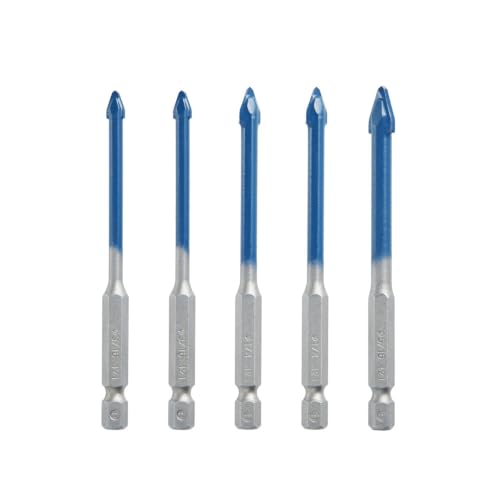
Five carbide bits made for hard tile: two 3/16-inch, two 1/4-inch and one 5/16-inch. Bosch lists them for porcelain, marble, granite and ceramic tile, and claims up to five times the life of its own glass and tile bits. The head is arrow shaped with a centering point to help it start.
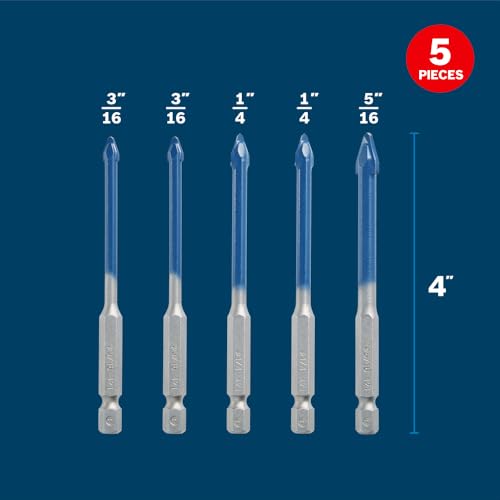
The hex shanks fit a normal three-jaw chuck. The listing says they also fit impact drivers, but I would still use a drill on tile. I explain why in impact driver vs drill.
Check the current price of the Bosch PTBX05 set on Amazon
DEWALT DW5572 1/4-inch diamond tile bit – a single diamond bit
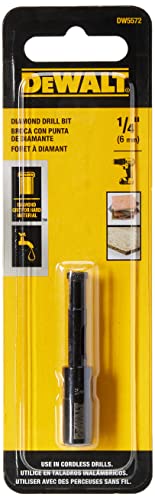
If you only need a few 1/4-inch holes for a towel bar or a mirror, one good diamond bit is enough. This one has a diamond welded tip, a reverse spiral that feeds water to the cut, and a slot for clearing the plug of tile from the core.
It is made for wet drilling, so keep the water going. 1/4 inch is the size many common plastic anchors need, but check the pack your anchors came in.
Check the current price of the DEWALT DW5572 on Amazon
DKIBBITH 10-pack dry diamond bit set – many sizes, no water
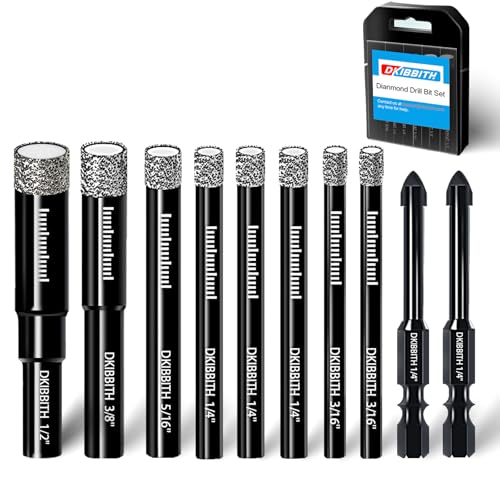
This set has hollow diamond bits in 3/16, 1/4, 5/16, 3/8 and 1/2 inch, with spares of the small sizes. The listing says each bit has wax inside that melts and cools the tip, so they are used dry, and that you should let the bit cool after each hole. The larger sizes are useful for pipes and bigger fixings.

DKIBBITH is not a brand I know, and I can’t speak for how long these last. I include the set because dry diamond bits are a practical choice for porcelain and the range of sizes is hard to find from the big brands at this price.
Check the current price of the DKIBBITH set on Amazon
Frequently asked questions
Can I use a regular drill bit on tile?
No. Wood and metal bits will not cut the glaze. They overheat, go blunt and can crack the tile. Use a carbide tile bit or a diamond bit.
Can I use a masonry bit on tile?
On soft ceramic it can work at low speed with tape, but it chips the glaze more often than a tile bit. On porcelain it will not get through.
Do I need a hammer drill to drill tile?
No. Hammer action is what cracks tile. You only need it afterward if there is concrete behind the tile, and only once the bit is past the tile.
Is it better to drill the tile or the grout?
Grout is easier to drill and keeps the tile out of danger. It is also weaker, so make sure the anchor sits in the wall behind and not in the grout itself.
Can I drill tile with an impact driver?
I would not. An impact driver starts hammering as soon as the bit meets resistance, and you cannot switch that off. A drill gives you steady rotation and full control of the speed.
How long does a tile drill bit last?
It depends on the tile. A carbide bit lasts a long time in ceramic and only a few holes in hard porcelain. Diamond bits last longer in porcelain if you keep them cool and do not force them.
What speed should I drill tile at?
Slow. Use low gear and a gentle trigger. If the bit or the tile gets hot, you are going too fast or pressing too hard.
The bottom line
Use a tile bit that matches the tile, tape the spot, switch hammer mode off, run the drill slowly and keep the bit cool. Change bits once you are through the tile, and fit the anchor into the wall behind it. Take your time. The whole job is ten minutes, and patience is what keeps the tile in one piece.